Discover Recommender system
Simple yet one the powerful machine learning algorithms

Welcome back to StatsTrail! Many of us today find ourselves endlessly scrolling through YouTube Shorts, Instagram Reels, or other social media platforms. You name a social media app, and there’s likely a large audience glued to it, unable to resist the addictive nature of these platforms. But what keeps us hooked? The answer lies in powerful recommendation algorithms.
With massive amounts of data—often measured in terabytes—companies can build highly accurate recommendation systems that shape our experiences across industries like social media, eCommerce, retail, and beyond. Today, let's dive into the basics of this fascinating algorithm.
What is a Recommendation system?
A recommender system is a machine learning–based analytical tool designed to provide personalized suggestions to users by analyzing their historical transactions, demographic information, and other relevant factors.
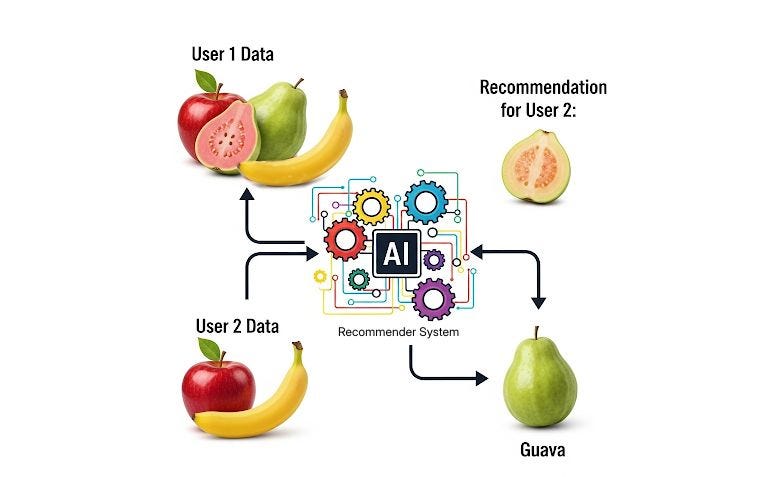
These systems can be remarkably intelligent, capable of identifying patterns in user behavior and inferring individual preferences by leveraging vast amounts of available data.
If a user watches several videos related to politics, a recommender system may suggest additional content based on various criteria, such as:
Other videos related to political topics
Different videos from the same creator previously watched
Videos that similar users have also viewed
The above recommendations can be driven by the user's own interaction patterns, by the behavior of similar users, by the content itself, or by a combination of these and other factors.
What are different types of recommendation systems
There are mainly three types of recommender systems
Collaborative filtering
This method is based on identifying patterns of similarity either between users or between items.
It has two primary approaches:
User based collaborative filtering (UBCF) - Recommendations are made based on the preferences of similar users.
If User A has purchased bananas, apples, and watermelon, and User B has purchased bananas, apples, and mangoes, then User A is likely to get recommendation of mangoes as well.
This approach is highly personalized but suffers from the cold start problem—it's difficult to recommend items for new users with no interaction history.
Item based collaborative filtering (IBCF) - This focuses on identifying items that are similarly rated or interacted with by users.
Lets say, some set of users has ranked item A and B as > 4, while C <=3 and D < 2. In this case for a target user who ranked A and B > 4, he more likely to get recommendation as product C than the D
IBCF is more scalable than UBCF and works well in large-scale systems. While it also faces the cold start issue, it can be mitigated by recommending popular or top-rated items.
Content based filtering
This method relies on the attributes or features of items.
For example, in the case of movies, attributes could include genre (horror, comedy, etc.), runtime, language, or director. If a user enjoys short horror films by well-known directors, the system will recommend other films with similar characteristics.
Content-based filtering doesn’t struggle with cold start issues for items, but providing deep personalization can be a challenge as it relies solely on the characteristic of the content
Hybrid system
These systems combine collaborative and content-based filtering to leverage the strengths of both methods.
For instance, movie or streaming platforms often recommend content based on both a user’s past behavior and the attributes of the content itself.
Hybrid systems are widely adopted across industries as they help mitigate common challenges such as the cold start problem and limitations in personalization.
Industry use cases
Recommender systems, from their basic forms to more advanced models powered by neural networks, are being widely adopted across a broad range of industries. Their applications are no longer limited to just social media or e-commerce platforms. Today, industries such as retail, telecom and even finance leverage recommender systems to enhance user experience and to drive engagement via providing personalized services.
Retail
In the retail industry, the abundance of transactional and customer behavior data enables the development of highly efficient recommender systems. These systems can identify and suggest the next best products to customers, improving both user experience and sales. Recommendations can be made at various levels—ranging from broad product categories to specific individual items—depending on the availability of high-performance system resources.
Telecom
In the enterprise division of a telecom organization, where a wide range of products and services are offered to businesses, recommender systems can play a crucial role. They help identify and suggest the most relevant products or service bundles tailored to each client's specific needs and usage patterns, enabling more targeted and effective sales strategies.
Banking and Finance
In banking and finance, purchases are typically driven by necessity rather than impulse. However, within specific product categories—such as credit cards—recommender systems can be highly effective. By analyzing a customer's transactional behavior, spending patterns, and financial history, these systems can suggest personalized credit card options that align with the individual's needs and preferences, thereby increasing the likelihood of engagement and conversion.
Travel and hospitality
The travel and hospitality sector has seen rapid growth in recent years and holds significant potential for further expansion. Recommender systems play a vital role in this industry by suggesting personalized travel destinations, hotel options, and travel packages based on user preferences, past behavior and seasonal trends. This enhances the customer experience and helps businesses improve engagements.
Closing note
Although they may appear simple on the surface, recommender systems are among the most powerful and impactful applications of machine learning today. When designed and implemented effectively, they can continuously learn and improve over time, significantly enhancing user experience and driving business growth through increased engagement and sales.